Monday, April 9, 2012

'Life on the 'Knife's Edge'


Two years ago, photographer Phil Kneen and myself set out to work on a project called ‘Harvest’, the story of a doomed Scottish fishing trawler and her 7 man crew, which went down with all hands in a raging storm off the Isle of Man in January 2000.

The idea had been to commemorate the 10th anniversary of the sinking in such a way as to tell the story from a completely different perspective, using the words of those most affected by the tragedy to recount the incredible story of what, is still, the worst maritime disaster to occur in Manx waters. The end project stirred up all sorts of emotions, reducing grown men to tears and testing mine and Phil’s friendship to the limit. It was a journey neither of us were sure if we could make again, but time, as they say, is a great healer……

And so, two years on, the creative juices are flowing again.

‘Life on the ‘Knife’s Edge’:

Tales from the Canadian Hinterland

Lying on the northern shores of the Great Slave Lake, some 500 kilometres south of the Arctic Circle, is Yellowknife, a city on the edge. This is frontier country, a land of ice road truckers and diamond miners, where you can enjoy the midnight sun, the AuroraBorealis and, apparently, the best fish and chips in Canada! The capital (and only) city in Canada's remote Northwest Territories, it is also the subject for our next collaboration.

Follow our adventures on...http://missluger.wordpress.com/


All photos and words copyright Phil Kneen & Trevor Gibbs


Friday, March 23, 2012

‘In the City of Djinns’


My latest adventure saw me riding across Rajasthan with Denise van Outen and Lydia Bright, as they attempted to raise money for Great Ormond Street Hospital. The following is a brief glimpse into the incredible journey that they undertook...
The adventure began amongst the chaos of Delhi and, in particular, its old Muslim quarter. Built by the Mughal emperor Shah Jahan in the 17th century, the labyrinthine streets of Old Delhi still exude a little of the magic and mystery of a city that is all but lost now amongst the bustling thoroughfares of India’s thriving capital. Once surrounded by high walls and dominated by the imposing majesty of the Red Fort, this is home to the magnificent Jama Masjid, India’s largest mosque and a spectacular piece of Mughal design capable of holding some 25,000 worshippers. This was where our journey began in earnest, as we headed out to explore the rambling back streets by rickshaw. 
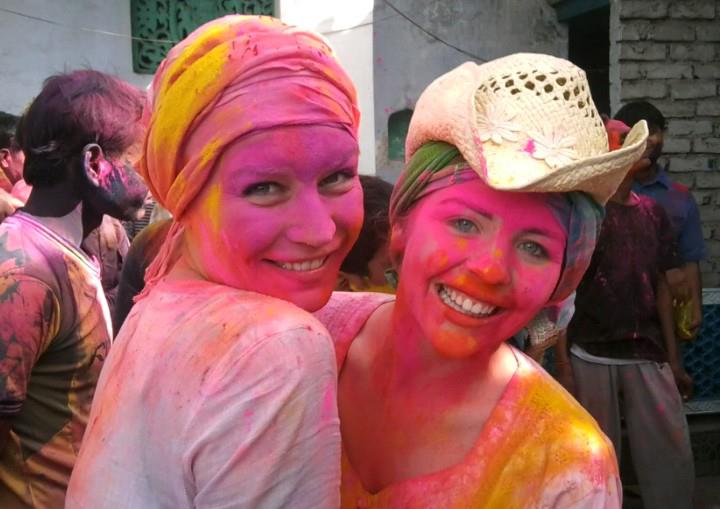
The city was beginning to take on a party atmosphere, with tomorrow heralding the start of the Holi festivities and, as we negotiated our way through the meandering streets, making our way past ruminating cows, spice stalls and tea houses, we could sense that celebration and mischief were in the air. The first water bomb came out of nowhere and hit Lydia. The second covered Denise in purple dye. Then suddenly, from all around us, water and dye hit us from every side. Our gentle amble through the back streets had turned into an ambush! 
Now rickshaws are not renowned for their speed, or their manoeuvrability. Neither do they offer particularly good protection against a concerted assault from water bombs and buckets. As water and paint rained down on us we made a frantic, but ultimately futile dash for safety. By the time we finally escaped the alleyways of Old Delhi we were a bedraggled and bemused mess, with Denise and Lydia bearing the brunt of the afternoon’s onslaught. Conversely (and bizarrely) our team photographer, Gareth, had managed to run the entire gauntlet unscathed. Whilst the rest of us looked as if we had just swum through blancmange, he still sported a pristine T-shirt and a sparkling camera. The Lord Vishnu obvious had his favourite!
And this was just day one!...

‘Don’t Worry...be Holi’


Even in a country renowned for its colourful exuberance, the festival of Holi takes some beating. A celebration to mark the beginning of spring and the triumph of good over evil, the annual Holi festivities explode across India in an all-encompassing cascade of water and colourful dyes. No one is spared, not even well dressed tourists...or celebrities.
As we made our way from Agra’s bustling train station, the early morning streets were alive with colour. Everywhere we looked people, dogs and cows were covered in brightly coloured paint and, given the events of the previous day amongst the meandering back streets of old Delhi, we were somewhat apprehensive as to what today might hold in store for us. We did manage to make it to the hotel unscathed, but this was to prove to be as far as we would get, before the inevitable mayhem overtook us. In the time it took to drop bags in rooms and change for our visit to the Taj Mahal, we had been joined by a travelling band of musicians and an enthusiastic collection of brightly coloured locals (including two dogs and a passing cow). 
By the time we left for the site we were all covered from head to foot in fetching multicoloured ensembles. The only bits of white that still seemed to be showing through were everyone’s grins! All of which made our visit to the Taj Mahal a memorable encounter, and not just for us. We became a source of amusement to the locals, as every step we took enveloped us in clouds of coloured dye. The security on the gate were somewhat unsure how to deal with us. And, once inside the complex, we seemed to be vying with one of India’s most iconic monuments for celebrity rights, as locals and tourists alike snapped away at us with cameras and mobile phones.
As the afternoon wore on and the celebrations ran their course, life began to return to a semblance of normality in Agra and we began the serious preparations for the bike ride ahead. It is said that one of the ultimate joys of travel is to be able to experience a little something of the true essence of a country and, on a journey of incredible contrasts, this brief encounter with one of India’s most colourful celebrations was to have a long-lasting and uplifting affect on us all...

‘In search of Sher Khan’


On the outskirts of the small town of Sawai Madhopur, lying in the shadow of an imposing hilltop fortress, sits one of India’s most famous national parks. Declared a Project Tiger reserve in 1973, Ranthambore National Park is today widely considered one of the best places in the country to see the majestic tiger in the wild. So, it was with some excitement, that we left our tented camp in the chill light of early morning to make the short journey to the park entrance. Only Lydia seemed a little unsure if she actually wanted to see a tiger up close and personal and, in light of what happened later, when she came face to face with a group of overzealous Rufous Treepies, I’m not surprised. 
The park itself covers nearly 400 square kilometres and was once the preserve of the ruling princes of Jaipur, who used it to hunt prey amongst the forested foothills of the Aravali and Vindhyan ranges. Today it is home to a rich diversity of animal and birdlife including wild boar, mugger crocodiles, nilgai, sloth bear and leopard and, although the tigers were proving elusive, as we drove along the rutted tracks that dissected the park, we came across herds of sambar deer grazing beside the glittering waters of a lake where crocodiles basked in the morning sunshine. We could also hear monkeys calling out warnings amongst the trees, indicating that a tiger was indeed hunting somewhere close by. All was going so well...and then the Treepies came! 
Rufous Treepies are members of the crow family, rather dapper members as it happens, with cinnamon coloured bodies and bluish grey tails. They are also incredibly intelligent and have obviously worked out over the years that tourists mean food! As we sat beside a small watering hole, taking in the tranquility of our surroundings, one came a sat on the roll bar behind the girls. This was obviously a ruse. Whilst our attentions were diverted two more came and sat on the edge of the open topped jeep’s windscreen, whilst another took up position on the wing mirror. In a scene reminiscent of Hitchcock’s ‘The Birds’, these canny creatures then pounced. The one at the back jumped onto Lydia’s head and sat there in resigned indifference as she screamed blue murder. Two more then made a beeline for Denise as she rolled helplessly about the back seat, convulsed in fits of laughter. 
Another ambush! There seemed to be a pattern forming here. First Delhi, then Agra, now Ranthambore...even the birds were getting in on the act! Maybe that’s what the monkeys had been trying to warn us about...

‘Onwards to the Pink City’


Extending from ancient ruins of the Mughal Empire, to the golden sands of the Thar Desert, Rajasthan is not without reason known as the ‘Land of Kings’. For centuries the brown hills of the Aravalli ranges provided the backdrop for some of the most opulent excesses of the Rajput princes. This is a land of forts and palaces, shimmering saris and splendid moustaches. A land still steeped in the traditions of the past, and one that warrants more than just a passing glance. Cycling along the meandering back roads provides the perfect way to discover a little of the true spirit of this incredible region. The dusty roads take you through villages filled with excited children and bemused goats, past convoys of camel carts and tree-lined fields where Rajasthan’s rural traditions continue much as they have for generations. 
Leaving behind the relative ‘sophistication’ of Agra, the journey took us through a chaotic maze of rickshaws, motorbikes and buses and out onto the highway that led west, towards the remarkable ghost city of Fatehpur Sikri and from there onto Bharatpur and the Keoladeo National Park. As the riding days became more challenging, so did the road surface, as tarmac gave way to potholes and potholes gave way to gravel. Herds of goats became a daily congestion problem and the deeper we headed into Rajasthan, the more our presence became an object of curiosity. Children were an ever-present distraction at drink stops and the incredulous looks that greeted us from beneath aged turbans testified to just how few tourists travel this route.
Muscles began to ache with more intensity as the kilometres fell away. Keoladeo gave way to Karauli, which in turn gave way to Ranthambore. We came across monkeys playing beside the road and enjoyed the hospitality of maharajahs and maharanis. We went in search of tigers and found a world far removed from our everyday lives. There was colour everywhere and, even through the dirt and the poverty, there were smiles in abundance. The end of the road came at a place called Ramgarh, just on the outskirts of Jaipur, where the palpable relief was made all the more welcome by the added attractions of a traditional Rajasthani band, a pantomime horse and a well deserved glass of champagne. 
We had covered over 420 kilometres, travelling in temperatures of nearly 40 degrees centigrade. The roads had, in some places, tested bikes and butts to the limit, but the girls had made it and, as they watched their bikes being packed away for the last time, thoughts turned to the next challenge...


...For more information go to http://www.charitychallenge.com

Wednesday, October 5, 2011

Petrolina Community Challenge, Brazil, June 2011


There are few things more likely to raise the spirits than the sound of a child’s laughter. It is a sound that I have heard often during my years working for Charity Challenge, and today was no exception. Although, to be fair, excited chaos would probably be a more fitting phrase to describe the scene before me. A week ago, where I stood had been little more than an empty collection of concrete shells, overgrown with weeds and littered with the dusty and broken reminders of neglect. However, in the space of five long, hard days, we had helped to transform it into a colourful crèche; one that now echoed to the shrieks and cries of hundreds of children and their bemused parents.
I had travelled out to Petrolina, in north-east Brazil, with a group of volunteers from Reckitt Benckiser. Our mission was to help with the renovation of two crèches for the local community, a project that would go a long way towards creating a welcoming and inspiring environment for the children. Our first day on site though had left a few feeling daunted by the scale of the work ahead. The playgrounds were a tangled mass of weeds, rusting metal and old car tyres, whilst the classrooms themselves were little more than a dingy collection of rooms filled with cobwebs and mosquitoes. 
Over the coming days though we cleared the jungle and removed the rubbish, built walls and sandpits and began to transform the crèches into canvases of colourful murals. We overcame heat and dust, giant toads and limping tarantulas. We cleaned floors and windows, tiled bathrooms and inflated enough balloons to launch a small car. We also had fun! Over the course of the week friendships were made and skills were learnt and by the end of it there wasn’t a dry eye in the house. 
People often tell me I have the best job in the world. Sometimes I disagree, but standing in the middle of that chaos, looking down at a grinning child covered in face paint and clutching a smiley balloon, I have to admit, they may be right.
Copyright Trevor Gibbs 2011

Wednesday, May 4, 2011

Flying in the Eye of the Wind!

Raileys, slingshots and back loops; life amongst the kitesurfers of Ellan Vannin

Jumping out of the van and climbing onto the top of a natural stone embankment, Dave gazed down across the sands towards the lone figure out on the water. The sun had already begun its lazy journey towards the distant horizon and Castletown was bathed in the rich hues of late afternoon. Little did Dave know it, but his life was about to change. As he watched, the surfer out on the water began to turn towards him, framed against the orange glow of the setting sun. Above him a huge red kite, emblazoned with the word griffin, caught the sunlight. This was Dave’s first introduction to kitesurfing and it was love at first sight. 

Still in its infancy, the sport of kitesurfing hit the adrenalin junkie scene back in the late 1990s. Described as the ultimate hybrid watersport, it is a combination of surfing, snowboarding and flying, with the kite propelling you through the water at exhilarating speeds and providing the necessary lift to perform some breathtaking stunts. At the back end of the last century there were no more than a few dozen kitesurfers worldwide, but today those numbers measure in the hundreds of thousands. Part of its big appeal lies in its ability to satisfy so many different criteria, as Dave explains. “I’ve always loved surfing and wakeboarding, but this guy was flying as well! This was a sport that fused the best of both, yet retained its own unique identity. I skateboarded a little when I was younger, but I had never felt that it was right for me. Could this be what I was looking for? I could surf a wave, ride back and surf the same break, again and again. I could jump 30 foot high! I had to get into this sport. I needed it in my life!”

Back in the real world Dave works for a double glazing firm on the island, where his fitting partner Nige and his manager Ian have both long been vociferous advocates of kitesurfing. After his introduction to the sport in Castletown, Dave was keen to continue his education, and Nige and Ian both seemed more than happy for him to tag along. Which is why he found himself heading up to Ballaugh on a cold autumn day some weeks later, to a spot that he was reliably informed would be ‘perfect nine metre weather’. Hideously underdressed, in a pair of board shorts and a less than flattering hoodie, Dave watched the guys performing, taking shot after shot with his camera as they mastered back loops and boosts out on the grey, foaming water. Dave was itching to get out there and join them, but Ballaugh is not the place to cut your teeth. Within the protection of the lagoon it can be a beautiful place to surf, but out on the open water the sea can hit you with all the fury it can muster and winds topping 25 knots can punish you big time.

It was actually back in Castletown, where he had first been introduced to the sport, that Dave finally got to indulge his new found addiction. It took him most of that winter and cost him some big slams, but eventually he mastered the board and the waves. Castletown is the most widely used stretch of beach on the island for kitesurfing. The prevailing southwesterlies and the geography of the surrounding coastline keeps the wave heights down in the centre of the bay and generally ensures a smooth wind. Usually its beautifully sandy too and on an incoming tide the place is just a dream to surf. The problem here though can be launching and landing, and not just on the high tide. The beach lies at the end of the island’s main runway and coming face to face with the undercarriage of an incoming flight from Liverpool can certainly get the adrenalin going. As Dave has discovered over the years, you learn fast how to keep your kite low when there’s a ‘bird in the air’!

Over the past three years Dave has learned a lot from photographing the local kiters on the island. A small community within a community, they are always keen to pass on tips and advice to other willing surfers and he appreciates the open friendliness and the social interaction too. There is never any hint of snobbery or cliques amongst the group and it seems that even the wives and girlfriends have accepted their addiction with good grace. Dave’s long suffering wife Katie is patiently tolerant of his excitable fidgeting whenever the winds pick up, and listens with equal understanding to his constant outbursts about raileys and flat 3s, even though she usually has no idea what he is talking about!

For such a small island the Isle of Man has a staggeringly rich vein of potential surf sites. As well as Castletown and Ballaugh, there is also Derbyhaven, which provides smooth, flat water and over a quarter of a mile of safe practice water on a low tide. No more than a metre in depth, it is great for trying out new tricks or perfecting old ones. The big thrill here apparently, especially for the freestyle fans, is at high tide. Derbyhaven comprises a sandy bar and a harbour that is protected by a water locked pier, which means at high tide it is pan flat, but at the harbour entrance, the tight rolling surf hitting the flat water produces a fantastic transition point which provides some perfect natural kickers. Indeed the island’s very size is its strength in many ways, because no matter which way the wind is blowing, there is always more than one spot to surf and its never more than about half an hour away, with Port Erin, Peel, Gansey and Laxey all providing equally exhilarating venues if tides and winds are fortuitous. 

For those looking to get in to this relatively new and exciting sport, the Isle of Man truly is a hidden gem that will, in Dave’s opinion, prove something of an undiscovered little gold mine for kite enthusiasts in the future. 

So, if you fancy trying something a bit different this summer, how about joining Dave and co and taking on the waters, and skies, around Ellan Vannin. 

For more information, check out the Isle of Man Kitesurfing page on Facebook.


© Trevor Gibbs 2011

Monday, March 7, 2011

Chajara: Horse whispering, healing and happy days ahead!


There is an old Arab proverb that declares the horse to be God’s gift to mankind. I reflect on those words now, as I watch a small, 6 year old autistic boy make his way across a muddy field in the early light of a crisp autumnal morning. In his wake follow two beautiful thoroughbred racehorses.

It was a scene that could have come straight out of a Hollywood movie. As it was, I was stood beside a field in a remote and tranquil corner of Bride, on a cold Saturday morning in late November. This is Chajara, a new and unique enterprise that is focused on the concept of healing through horses. The brainchild of Charlotte Mackenzie and Rachel Smith, it began life a few months ago, when the pair were generously gifted three horses from the Shadwell Estate in Thetford, England. Charlotte takes up the story: 
‘I had returned from Dubai full of the desert and I wanted to bring that connection and all the positive things that had happened to me out there back home. I’d been in the thoroughbred racing industry for over 20 years and out in the Middle East I had been working with one of Sheikh Hamdam bin Rashid Al Maktoum’s trainers, so I approached my contacts there to see if they would be willing to help. Amazingly, the Shadwell Estate jumped at the chance to help. Other centres in the UK have had a lot of success with using ex racehorses in rehabilitation and education programmes, but there is nothing like it in the Isle of Man, so I wanted to try to give something back, both to the horses themselves and to the people who would best benefit from their contact with them.’
One such person is young James, who has been coming here for a few weeks now. His contact with the horses seems to have had a profound affect on him, something that his mother has become all to aware of, as she goes on to explain.  ‘Because he doesn’t speak, James can’t tell anybody what he wants and he gets very frustrated. Children with autism have a totally different perception to things; they see and hear things differently. Here he can be totally chilled, just wandering around and checking things out. This is perfect. He has freedom and there is no noise, its absolutely gorgeous.’
The seeds of this innovative idea were first sown on a small farm in rural Ontario, Canada, where, as a child, Charlotte watched her parents dealing with the children of their city friends. Each summer, the farm would become a haven for kids from the suburbs, who were able to channel their energies into positive pursuits; energies that may have otherwise have sent them down a different road entirely. It is a memory that has stayed with Charlotte all her life and one that will ultimately turn Chajara into a proper farm, one where people; whether they be children or adults, special needs or simply troubled, can come and heal. Both Charlotte and Rachel are aware that it is a process that works both ways. ‘I remember how I was transformed going through the process on the farm’, says Charlotte, ‘I was a city kid and I was not happy. I was troubled. Then my parents go out and buy a farm and my whole life changed.’ Even Rachel’s own children have benefited from their association with the horses and all three are now more than happy to wander around a field with an oversized wheelbarrow and a shovel collecting horse manure. Chajara is very much a family orientated enterprise.
A qualified Equine Sports Massage Therapist, as well as a Reiki practitioner, Charlotte first met Rachel four years ago when Rachel attended a healing session. The pair connected straight away and as Charlotte began to contemplate more and more the whole idea of Chajara, she turned to Rachel as a kindred spirit. Rachel also comes from a horse racing background and both seem to compliment each other perfectly, with Charlotte readily admitting that it is Rachel’s steadying influence that keeps her firmly earthbound. But with the dream now beginning to take shape, both fully admit that what they really need are better facilities and funding. The field they are currently using has been unselfishly loaned to them by Charlotte’s neighbours, but as the enterprise grows, both realise that they will soon outgrow their current location and are looking around for more suitable premises.
With the growing interest surrounding the recent book and film of ‘The Horse Boy’, Rupert Isaacson’s moving account of his own spiritual journey of discovery with his autistic son Rowan, Charlotte and Rachel are keen to capitalise on this renewed belief in the power of the horse. Charlotte openly admits that Isaacson’s story was a big inspiration to her and she approached him for advice and feedback when she first conceived the idea, finding him incredibly supportive and helpful.
The ultimate aim is to provide a centre where there will be opportunities for people - children and adults alike - to learn the social skills that most of us take for granted and to examine their own needs and relationships through their interaction with the horses. Speaking to James’s mom, it seems that Chajara fills a need that is greatly lacking on the Isle of Man and she would love to see it expand so that more children like her son could benefit. In the UK, places like the Greatwood Charity have been helping to rehabilitate former racehorses and children with special educational needs for years, but this is the first such venture over here. As Charlotte points out ‘...there isn’t actually a centre where children, or whoever, can come and have nature, horses and healing all in one place. When James first came here he was very wary of getting dirty. Today he was happily wading through mud in his wellies with the other children. You can’t package that. That is the essence of nature.’ 
Winston Churchill once wrote: ‘There is something about the outside of a horse that is good for the inside of a man’. Looking around me at the smiles on the faces of young James and Rachel’s own three children, I can well believe that. Chajara seems to appeal to a basic need in all of us, one that many of us tend to lose sight of amongst the hustle and bustle of everyday life. As Charlotte so eloquently puts it, ‘...its all so authentic somehow. Horses see through the hypocrisy and the facade’.
For more information about Chajara contact Charlotte Mackenzie or Rachel Smith at Chajara@hotmail.com, or take a look at the ‘Chajara, Healing Through Horses’ Facebook page.


Friday, January 21, 2011

Travels with Martina: A journey to the Roof of Africa with a tennis legend

For Martina Navratilova, the evening of December 9, 2010, was to prove an ignominious end to what had been a particularly tough year. As she lay strapped to a stretcher, breathing from an emergency oxygen supply, the winner of 18 Grand Slam titles had chance to reflect on a year that had begun with her breaking her wrist, had then seen her diagnosed with breast cancer and was now ending with her being evacuated off a mountain with a life threatening case of high altitude pulmonary oedema.

Part of a team of athletes, journalists and volunteers, raising funds for the Laureus Sport for Good Foundation, the ex-Wimbledon champion had been attempting to reach the summit of Mount Kilimanjaro, Africa’s highest peak. By day four though, just over 2000 metres short of the summit, the combination of a debilitating stomach bug and a build up of fluid in her lungs had prompted the decision to undertake an emergency night-time dash off the mountain. The next four hours saw her being carried down the mountain by a team of porters, where a vehicle was waiting to drive her to a local medical facility, to be flown on to a hospital in Nairobi.

For me though, this was just one incident in what was turning out to be one of the hardest treks I had ever done. I had been employed to help lead the team to the top, but since we had set out from Marangu four days ago we had seen nothing of Kilimanjaro’s famous snow-capped crater. Instead, we had endured days of torrential rain and driving blizzards and by the time we reached the camp at Horombo many of the team were beginning to feel the effects of both the mountain and the weather. And now I had the added problem of our major celebrity disappearing on a stretcher into the inky abyss of an African night. The team that remained behind though still included some notable personalities, including British Olympic Badminton star, Gail Emms, and Michael Teuber, a German Paralympic cyclist, who over the coming days was to prove an inspiration to many in Martina’s absence.

The morning following Martina’s sad departure we began the long hike up to Barafu Camp, the usual expansive views being replaced again by enveloping cloud and a steady driving rain, which over the course of the next 8 hours turned into a full raging blizzard. By the time we reached our summit camp many were beginning to seriously doubt their ability to make it to the top the following day and I had to admit that without some favourable intervention by the weather gods even I was doubting our chances of making it. The mess tent and the porters’ kitchen that evening took on the semblance of a Chinese laundry, as gloves, waterproofs and hats were hung from every available space in an effort to dry them out.

That night we retired to bed early, ready for a midnight attempt on the summit, and it was with some trepidation that I unzipped my tent just a few hours later to check on the weather. The sky above me though was a blaze of stars! It seems that our prayers had been answered, and as we began the long climb to the top, the valley echoed to the encouraging songs of our Tanzanian guides. As we progressed up the mountain I kept casting nervous glances to the heavens above, wondering how long the skies would remain clear, but as we approached Stella Point and the rising sun began to cast its warming glow across the landscape, it became clear that we would finally get to see Kilimanjaro in all its majestic glory.

In spite of the weather and the far from favourable condition, 18 of the team made it to the top and it was a very happy group of people that were reunited with Martina three days later at Nairobi’s Jomo Kenyatta International Airport. For many it had proven to be a far tougher challenge than they could ever have imagined and, in spite of its recent popularity amongst trekking groups, Martina Navratilova’s near fatal encounter had heralded for many a much needed reminder of the dangers of underestimating a journey to the summit of Africa’s most iconic mountain.

Copyright Trevor Gibbs 2011


Tuesday, January 11, 2011

On 12th January 2010 the Haitian capital of Port au Prince was devastated by an earthquake that left nearly 250,000 people dead. One year on and many of the survivors still have no hope of a stable future and probably didn't have much of a Christmas either. Its a sobering thought isn't it.


Six months after the original quake I went out to Haiti with a team of journalists from GMTV and the News of the World. Below is a link to a short BBC audio piece that followed my visit.

http://news.bbc.co.uk/local/isleofman/hi/people_and_places/newsid_8882000/8882370.stm

Tuesday, February 16, 2010

'Harvest'

Photographs by Phil Kneen

Words by Trevor Gibbs


On the 17th June 2010 an exhibition opens at the Villa Marina, Douglas, commemorating the tragic events that surrounded the sinking of the scallop dredger Solway Harvester 10 years ago. Through a series of photographs and interviews the story will be told by those most directly affected by the tragedy, to produce what will hopefully be a fitting and lasting tribute to the memory of the Solway Harvester and the incredible efforts made by the Isle of Man to recover the boat and its crew.

The exhibition is being held until the end of July, so please come along and support it. It is a story that has grown in the telling over the past months and one that deserves to be heard properly.

Sunday, January 31, 2010

Harvest, an update...


...The Irish Sea passed the 10th anniversary of the sinking of the Solway Harvester in a tranquil mood of quiet serenity. The pounding seas of that fateful night had been replaced by a grey and sombre shroud, the silence broken only by the lofty shrieks of passing gulls and the occasional dull throbbing of a boat’s engine.

As we enter 2010 the Harvest project has embarked on a new phase, one that has seen myself and Phil photographing and interviewing some of the people who were directly involved in the search and recovery operations here on the Isle of Man. These interviews have seen us meeting up with people from the Department of Home Affairs and the RNLI, with journalists who were there when the boat made its final silent entrance into Ramsey Harbour and with fishermen who shared the anguish of the families that night: men who but for the grace of God and a fair wind, could have found themselves in the same situation as the doomed crew of the Solway Harvester.

Talking to people, it’s interesting to hear how they first got news of the tragedy. Like memories of 9/11 or the death of Princess Diane, these isolated stories are little cameos in their own right, orbiting around the bigger story like tiny satellites. Paul Caine, the mechanic on the Peel lifeboat, had spent the evening listening to the drama unfold at home, whilst Daphne Caine (no relation) from the Department of Home Affairs, who was on her honeymoon at the time, read of the sinking whilst cruising the Caribbean. Their subsequent roles in the unfolding events could not have been more different either. Just a few hours later Paul found himself searching the boiling seas for the missing trawler, whilst Daphne returned to the full glare of the world media, as she took on the task of Dudley Butt’s press liaison officer.

The tendrils of this tragedy seem to spread out like an uncontrollable virus, touching people in a myriad of different ways, evoking sadness and hope, pity and anger, but always leaving behind a story or a memory that will remain long after the boat has finally gone. I don’t think Phil or myself ever envisaged how much of an affect it would have on us when we began this project, but the more we hear of how it has touched people’s lives, the more we feel inspired to do it justice.

And this is where you out there can help. The one thing we do need help with is funding. Besides the exhibition we also want, if possible, to produce a book to accompany the event; something that will provide more meat to the bones of the story. We would also like to be able to exhibit the photos in Whithorn as well if possible, so that the families and friends of the crew can view them. If anyone feels willing or able to contribute something therefore, or indeed has any idea of possible leads we could follow up, then please let us know.

Neither Phil nor myself intend making any money from this enterprise, but we would like to be able to make it a worthy testament to both the crew of the Solway Harvester and to the incredible role played by the Isle of Man in their recovery, with any excess funds being donated to either the families, the RNLI or the Fishermen’s Mission.

© Trevor Gibbs 2010

Monday, January 11, 2010


The Solway Harvester, continued...

The search for the Solway Harvester pitted man and machine against the unrelenting fury of the Irish Sea. Over the next few hours Mother Nature’s unbridled power held sway, and in spite of Herculean efforts by the coastguard, the RNLI, the RAF and the Royal Navy, the boat and its seven man crew failed to materialise from the enveloping darkness. The search was finally abandoned at dusk on the evening of the 12th January, when two unopened life-rafts shattered any last vestiges of hope that the crew would be found alive.

Over the coming days the Irish Sea remained loathe to give up her prey, and it was another three days before the wreck of the Solway Harvester was finally located, lying 11 miles off the Isle of Man in some 35 metres of water. She lay like some slumbering leviathan, silent and brooding, her seven man crew still aboard, together in death as they had been in life.

Aboard the Royal Navy minesweeper HMS Sandown the mood changed dramatically as one of her submersibles approached. As her captain, Ben Key, said: ‘I remember vividly the silence that descended in the Operations Room as the trawler became visible, the name Solway Harvester emerging from the gloom. We were all struck by how a vessel that had been so alive just a few days before could now be so silent and still’.

Having given their word to the families of the crew that they would bring their boys home, the Isle of Man government now committed nearly a million pounds to the recovery operation, incurring the wrath of the British government in the process. The Irish Sea too remained an intractable foe, and like a jealous lover continued to grip the boat and her human cargo in her icy embrace. Undaunted, the salvage teams and divers refused to be thwarted, and the boat and its crew were finally raised and returned to Douglas some weeks later, to the haunting lament of a solitary piper.

The journey home had been a long and painful one, but despite the tragedy of the loss, it is a journey filled with hope. It saw men and women risk their lives in atrocious conditions that fateful January night. It saw politicians stand up for what was right, rather than what was expedient. And it saw two communities come together in grief and remain together in friendship. It is time to lay the Solway Harvester to rest now, its rusting hulk has served its purpose: but isn’t it inspiring, in these days of greedy bankers and expense scandals, ruthless bombers and pointless wars, that a story can still be told of the inherent goodness and indomitable resolve of the human spirit.

To the memory of the crew of the Solway Harvester:

Craig Mills
Robin Mills
David Mills
Martin Milligan
John Murphy
David Lyons
Wesley Jolly

"We are tied to the ocean. And when we go back to the sea, whether it is to sail or to watch - we are going back from whence we came."
John F. Kennedy

© Trevor Gibbs 2010

Wednesday, January 6, 2010


‘And now the Storm-Blast came, and he
Was tyrannous and strong:
He struck with his o’ertaking wings,
And chased us south along.’

The Rime of the Ancient Mariner - Samuel Taylor Coleridge


It was an almost surreal feeling, sitting in the bar of the Steampacket Inn on the Isle of Whithorn, contemplating death whilst gazing out across a tranquil harbour bathed in late December sunshine. The scene before us had probably changed little over the past ten years. That same somnolent setting was probably the last view of home that the crew of the Solway Harvester had seen as they sailed out on the 10th January 2000, to meet their fate at the hands of an unforgiving sea.

An idea that had originally begun as a conversation in another pub, on another isle, some four months previously (was it really only four months?), the Solway project has grown into an unstoppable juggernaut over the past few weeks; only slowing down to pick up members of the RNLI, the Manx Government, the Royal Navy and an assortment of police officials, coastguard personnel and church ministers along the way. What had started as a flickering light somewhere in the dark recesses of Phil’s mind had now entered the consciousness of folk both here in Whithorn and back at home on the Isle of Man. We had people eager to get involved now, including such luminaries as Donald Gelling and Dudley Butt, who had already furnished us with a wealth of anecdotes and stories relating to the recovery of the vessel, as well as the likes of Ben Key and Robert Corran, respective skippers of the HMS Sandown and the Douglas lifeboat: men who had faced the full might of the raging storm that night in an effort to locate the missing scallop dredger and its 7 man crew.

We were in Whithorn to meet up with some of the families and I think the reality of what we were doing was finally kicking in. How do you ask someone about their dead son? How do you introduce yourself to a woman who was heavily pregnant when her husband drowned, and then look into the face of the 9 year old boy who had never even met his father? Myself and Phil had retired to the bar under the vague, and it has to be said lame, understanding of undertaking a planning meeting. We were fooling no-one. Not even ourselves if truth be known. We were actually hoping that an infusion of strong liquor would steady the nerves prior to our first meeting with the parents of Davy Lyons, a 17 year old lad, who at the time of his death hadn’t even been big enough to join the army!

Parents shouldn’t have to bury their children, its against nature, but over the course of the following weekend we met with three families who had done just that. Two of the boys had been 17, inseparable friends who had a lifetime of experiences ahead of them. The other had been just 22. A combined age of 56, all gone in the space of probably less than 20 minutes. Then there was Karen Jolly, whose husband Robin had been the brother of the Solway’s skipper. We sat and listened to her tell us about the last Christmas they had spent together. Not once did we feel uncomfortable or intrusive. These people were more than happy to share their memories and it wasn’t a feeling of senseless waste that we came away from Whithorn with, but rather an indomitable mood of quiet dignity and, it has to be said, hope. Whilst the memories were still raw and the anger still palpable, the spirit that remained was undefeated.

You have to wonder how they spent this past Christmas and New Year, the 10th anniversary of the sinking doubtless tinging the festivities with some sadness. From our perspective it has probably focused our resolve to do the project justice, to give them something to remember. The one overriding response we got whilst we were in Scotland was how grateful they were to the Isle of Man for what they did to bring the boys home. The island went against every previous precedent, every piece of bureaucratic advice and even the British government itself to raise the boat and recover the crew. The Manx people should be proud of what they achieved and if any of you fancy a quiet drink in the Steampacket Inn in Whithorn, just tell them you are from the Isle of Man...

....to be continued

© Trevor Gibbs 2010

Harvest

A testament to the power of the sea and the indomitable spirit of man


On the 10th January 2000, the scallop dredger Solway Harvester left her home on the Isle of Whithorn and sailed south, towards the fishing grounds that lie off the coast of the Isle of Man. Aboard the vessel were seven men, including two 17 year old friends. It was to be the last time their families would ever see them alive.

Over the next 24 hours the weather in the Irish Sea began to deteriorate, to the point that the water around the boat turned from a dark foreboding mass to a screaming cauldron that threatened to engulf them. The Skipper, Craig Mills, decided that the time had come to head for shelter, so on the afternoon of the 11th January the crew hauled in their gear and the Solway Harvester headed for a safe haven in Ramsey, on the north coast of the Isle of Man. It was their final journey. At 17.47 a satellite picked up the signal from the boat’s emergency positioning radio beacon, indicating that the vessel had finally lost its battle with the engulfing waves that were battering it.

A search and rescue mission was immediately launched, with elements of the RNLI, Royal Navy and RAF launching into the increasingly fierce storm to try to locate the boat and her crew. The ferocity of the storm forced the likes of the Workington lifeboat to turn back and even defeated the best efforts of the RAF helicopters, and at dusk the following day the search was finally called off, when the boat’s two life-rafts were found, unopened. It took three more days to locate the vessel, lying in some 35 metres of water just 11 miles off the coast of the Isle of Man. All seven crew were still on board.

From the time of the last known communique from the boat, to the time that the EPIRB was activated was just 18 minutes. The crew hadn’t even had time to get on deck.

‘Harvest’ is a joint project between myself and Phil Kneen to document what happened over the coming days, to tell the story from the perspective of those most deeply affected by the tragedy - rescue crews, families and friends. This will be their story, told in their own words and accompanied by portraits taken by Phil. The final exhibition is due to be unveiled sometime later this year.

© Trevor Gibbs 2010

www.philkneen.co.uk
www.agamaconsultants.co.uk

Tuesday, May 12, 2009

ENTER THE DRAGON


What did I want to do for my birthday?

As questions go it seemed fairly innocuous. How about going for a Chinese I said? Somehow though this wasn’t quite what I had in mind. I pressed my nose against the glass and peered out into the inky darkness. Thirty thousand feet below me central Russia lay slumbering beneath a blanket of stars. I was headed for Beijing and a date with a duck.

Few things in life can prepare you for Beijing; everything about it is, well foreign. For centuries it was the centre of the Chinese universe, the sun around which the empire revolved. Established as a capital by Kublai Khan in 1264, today it still holds sway over the vast landmass that makes up the Peoples Republic of China, its directives as much a mystery to the peoples of its outlying provinces as they are to us. A sprawling mass of glass, concrete and humanity, hiding within it some of the finest examples of the Imperial Age left on earth.

Its streets are huge wide thoroughfares, dead straight and aligned along east-west and north-south lines. Branching off from these vast boulevards are networks of dark alleyways, or ‘hutongs’, which snake and twist away from this central grid, their narrow passageways crammed to overflowing with produce, people and livestock. My hotel was situated in the centre of a network of these alleyways, the streets around it a cacophony of noise, colour and smells. I wandered aimlessly, picking my way past stalls and carts creaking under the weight of people and produce. At my feet bags and buckets thrashed about wildly, their occupants, a bewildering mix of frogs, snakes and fish, all apparently desperate to add to the general melee and confusion. I allowed myself to be swept along on a wave of humanity. Movement in Beijing is a constant flow, a ceaseless river: as a space becomes available it is immediately filled, by a cart, a bicycle, a person. I flowed along with it, a stranger in an even stranger land.

The following morning dawned clear and bright. I intended to spend it exploring the delights of the Imperial Palace and the Forbidden City. When you consider the wanton destruction of so much of the majestic beauty of the Imperial Age by successive hordes of Japanese, Koumintang and Communists troops, it is a miracle that monuments such as the Imperial Palace remain at all. In the 1940s there were 8000 temples in old Peking, by the 1960s these had been reduced to just 150. Small wonder then that a jewel like the Forbidden City gets 10,000 visitors a day.

So named because for 500 years it was off limits to all but a privileged few, the Forbidden City is the largest and best-preserved collection of ancient buildings in China. Once home to two dynasties, the Ming and the Qing, it covers an area of some 720,000 square metres and contains 800 buildings. It is estimated that it takes 10 years to do a full renovation of the Imperial Place, by which time the whole process is ready to begin again. It is opulence on the grandest scale and from the moment I entered through the massive portal of the Wumen Gate and looked out across the massive courtyard towards the Three Great Halls at the heart of the city, I was spellbound.

Crossing the Golden Stream, shaped to represent a tartar bow and spanned by five marble bridges, I wandered into the heart of the city. The Hall of Supreme Harmony is the most important and largest of the Three Great Halls. Raised on a marble terrace and originally built in the 15th century, it was used for ceremonial occasions. The entrance to the great hall is flanked by two huge incense burners and inside the hall is a fabulously decorated Dragon Throne from where the emperor would preside over his prostrate court as they banged their heads on the floor nine times. The western and eastern sides of the city house what were once the living quarters of the Emperor and his entourage. These buildings, containing once the libraries and temples, theatres and gardens of the great city, now house museums of bronzes, ceramics and Ming dynasty art. The exceptions are the Western Palaces, formally the living quarters of the empress and the concubines, which have remained untouched and today display the finery and trappings of a court of immense wealth and power.

The northern end of the Forbidden City is taken up with the Imperial Garden, a quiet haven of 7000 sq. metres, containing walkways and pavilions that are set in a classical landscape. I sat there, bathed in the glow of the late afternoon sun, taking in the decadent splendour of a bygone age and I could possibly be sitting there still were it not for the fact that I wanted to see Tiananmen Square before heading back to the hotel. Tiananmen is the heart of Beijing, a vast concrete desert, bounded on all sides by memorials to the past and present. Chairman Mao lies in state in his marble mausoleum here and every day crowds flock to gaze upon his corpse, or stand before the Monument to the Heroes. Much of the world still identifies Tiananmen with the ill-fated pro democracy riots of 1989 and the harrowing scenes of troops and tanks pitted against unarmed students, but as I stood here now it was difficult to equate the scene before me with those images of two decades ago. All around me families were making the most of the rapidly disappearing summer, children played and laughed and above my head huge kites of dragons and eagles swooped and spun in a colourful dance across the sky. My plan had been to stay and watch the flag lowering ceremony at sunset, before heading back, but the overwhelming mass of humanity flooding into the square made me think again. I left the square to the growing masses and headed back to the hotel.

Early mornings in Beijing are a time for the good citizens of this vibrant metropolis to indulge their passions before beginning the rigours of the day. So the following morning found me creeping out of the hotel and into the waking city just as the sun was beginning to rise. I was headed for Tiantin Park in search of culture, excitement and ballroom dancing! Tiantin means Temple of Heaven and the park itself is widely regarded by many as the perfection of Ming architecture. It was conceived as the meeting point of heaven and earth and for 500 years was the heart of imperial ceremony and symbolism. Once considered sacred ground it would have meant certain death to enter. Nowadays the price is slightly less exacting at just a few yuan.

It was a strangely discordant collection of sights and sounds that greeted me as I entered the park. Even at this hour it was full of people. Old men strolled past, deep in conversation, their hands tightly gripping bamboo cages that echoed to the warbling tones of solitary songbirds. Beside me an old man went through the unhurried trance like forms of Tai Chi, his sword reflecting the morning sun as it cut a gentle curve through the still air. Next to him middle aged couples dipped and spun to the distorted strains of a waltz. Suddenly the air was filled with the screeching wails of Chinese Opera and all around me the park seemed to come alive with movement and noise. Shaken from my reverie I moved off to explore the park.

Set in an area of some 270 hectares, the Temple of Heaven is a bewildering array of colour and symbolism. The four gates that lead into the park are set on the four compass points and the structures within are a numerologists dream. The temple buildings are all circular and set onto square bases, deriving from the ancient Chinese belief that heaven was round and the earth square. The centrepiece of the whole complex is the Hall of Prayer for Good Harvests, a magnificent structure mounted on a three-tiered marble terrace and topped by three blue tiled roofs. It was here that the Emperor came to pray for the coming harvests and seek divine approval for the coming year. What makes this structure even more remarkable is the fact that it is made entirely of wood and stands without the aid of either nails or cement. I spent the morning visiting the buildings that make up the rest of the complex; The Imperial Vault of Heaven, The Round Altar, whose entire geometry revolves around the number nine (considered a divine number amongst the Imperial Chinese) and the Echo Wall, said to be a perfect whispering gallery, although somewhat difficult to prove amidst the general noise and chatter.

From Tiantin I headed across Beijing to the Lama Temple, which, according to my guidebook, was not only the most colourful temple in Beijing, but also the most renowned Tibetan Buddhist temple in China. Originally the former domicile of the Emperor Yong Zheng, it became a temple, as was the custom, upon his improved social status. In 1744 it was converted into a lamasery, becoming the residence for large numbers of monks from Mongolia and Tibet. Miraculously it survived the Cultural Revolution intact and today serves as an active Tibetan Buddhist Centre, although that is a somewhat contentious title, given the current Chinese policy towards Tibet.

Politics aside though and irrespective of any religious authenticity, the Lama Temple cannot be faulted as an aesthetic experience. Everything about it is a visual delight; its gardens, its frescoes, its tapestries and the heavy smell of incense all lend a magical quality to the place. At the heart of the temple is an 18 metre high statue of the Maitreya Buddha in his Tibetan form. Sculpted from a single piece of sandalwood and clothed in yellow satin, it is a truly inspiring sight. My personal favourites though were the Nandikesvaras, the copulating figures that had earned the lamasery its reputation as China’s most illustrious sex manual, one used to educate the sons of the emperor himself.

All this culture was making me hungry and I did, after all, have a birthday appointment to keep. The Chinese love to eat and can certainly boast one of the finest cuisines in the world. Beijing duck is probably the capital’s most famous culinary offering. The unfortunate duck is first force fed a diet of grain and soybean paste to fatten it up. Then it is lacquered with molasses, pumped with air, filled with boiling water, dried and finally roasted over a fruitwood fire. At some stage during this process one would also hope that it is killed. The whole process may appear a touch barbaric, especially if you are a duck, but the end result, I can assure you, is delicious. I feasted on duck soup, tender strips of duck with plum sauce and crepes, fortune cookies and Chinese beer, although I am pretty sure that the last two were not directly attributable to the duck.

And so ended my first couple of days. I still had the spectacles of the Summer Palace and the Great Wall to see, but as for the delights of Beijing itself, well it had certainly not disappointed. On the surface it is a city like many others, drab and dirty, a seething mass of humanity. But within its vast boulevards and crammed hutongs it hides a breathtaking array of beauty, reminders of an age of opulence and splendour at odds with its communist doctrines. It is a living paradox and with the onset of a new Imperial age for China and its headlong rush into the 21st century let us hope that these reminders of its previous golden age are not forgotten.

© Trevor Gibbs 2009

ADVENTURES IN ABYSSINIA


The Hyenas had vanished back into the darkness some time ago, seeking shelter from the driving rain. I should have gone with them. I had come to Ethiopia in search of adventure, but standing on the rooftop of a hotel in the small hours of a Friday morning, in the midst of a storm of almost biblical proportions, was not something I had bargained on. Neither had I envisaged spending my last hours in the country trying to talk an evangelizing, and very drunk, American down off the aforementioned roof

We were in a town called Harar, situated in the foothills of the Chercher Mountains, some 150 kilometres from the Somalia border. This was a town of conflict and contrast, a microcosm of African life, where Muslims and Christians had brokered an uneasy truce and the streets and alleyways positively screamed with colour and noise. For centuries the town had been a crossroads, an entrepot of commercial trade from Africa, India and the Middle East. It was from here that the Muslim armies of Ahmed Ibn Ibrahim al Ghazi had swept forth in a holy jihad against the Ethiopian Orthodox Church. This was a town with attitude, which still had a xenophobic mistrust of foreigners and the largest chat market in Ethiopia. This was not a town for drunken American evangelists.

I had flown into Addis a few weeks before, my ears still ringing from the inevitable, and it has to be said ill informed, comments of family and friends. Ethiopia still has a serious image problem. Years of news reports on famines and droughts and the seemingly endless conflicts with neighbouring Eritrea have clouded the perception of the outside world. This is a shame, because the reality is very different. Ethiopia is an undiscovered gem. Home to one of the oldest Christian civilizations in the world, it has an archaeological pedigree to match any of the great civilisations of antiquity and a cultural and natural diversity that can compare with anywhere in Africa. True it is one of the poorest places on the planet, but this is a country that has a heritage and a history stretching back millennia. Great empires rose and fell here whilst our ancestors were still running around in animal skins and woad mascara.

Addis Ababa is a relatively new city for a country that can boast such an ancient pedigree. An eclectic mix of the old and the new, where concrete and glass vie for space next to wattle and daub shacks and donkeys and taxis bray and honk in unison along the wide-open boulevards. But for all its potential it is still just a city, so first chance I got I headed north, towards Bahar Dar and Lake Tana. It is from here that the Blue Nile begins its 4,000 mile odyssey through sub-Saharan Africa, to meet up with the White Nile at Khartoum in Sudan before continuing north, to the shores of the Mediterranean.

It is a strangely unassuming beginning for such an epic journey. The river flows gently from the lake, between low lying islands ringed by papyrus and overgrown with jungle, its passing marked only by the odd lone fisherman in his papyrus boat, or a yawning hippo, basking in the early morning sun. It is not until it gets to Tissisat Falls that it begins to take on the mantle of a great river. Here it becomes the ‘smoking waters’ of legend, as it cascades over a sheer chasm and churns its way through a narrow-sided canyon. This was once one of the most spectacular waterfalls in Africa, a thundering torrent that was believed to contain evil jinns: demons waiting to grab the unwary and drag them down to a watery grave. These days, thanks to the building of a hydro-electric dam, the falls are a shadow of their former selves, but still impressive nonetheless and after the rains you can still imagine the odd demon waiting in the shadows for anyone unwise enough to stray too close.

Local transport is probably one of the best ways to truly appreciate travel in a foreign land. How can you not feel an empathy with a country and its people when you spend your days travelling on an old rusting bus next to a man with a loaded Kalashnikov! From Tissisat Falls I headed north, along dusty pitted roads into the religious heartlands, to the city of Aksum, reputed home of the fabled Ark of the Covenant itself. It was a journey that was to take me through a timeless landscape encapsulating something of the true diversity and history of this ancient kingdom. Sharing our road with cattle, chickens and a seemingly endless procession of large black umbrellas, I passed the days looking out across an ever changing tableaux: magnificent Imperial castles and lines of burnt out tanks, mountain plateaus where the breathtaking views where punctuated by uncountable hordes of Gelada baboons and all enveloped by a way of life that had remained unchanged for millennia.

We arrived in Aksum in time for the Easter celebrations, an important time for the Orthodox Christians. Of the numerous religious festivals practiced by the Ethiopians the two most important are Timkat and Easter. The three-day festival of Timkat is certainly the most colourful, Easter though has always required a more committed approach to worship. Fasika is the Orthodox Easter and marks the end of a fast that has lasted some 55 days, during which time no animal product at all can be consumed. Even the more traditional approach to Easter requires the populous to fast from the Thursday before Good Friday until the end of the Easter services at 3 am on Easter Sunday. The end of Easter in Ethiopia is something of a blood fest as the streets quite literally run with blood, not a good time to be an animal, or indeed a vegetarian.

My plan was to spend a few days here, recuperating from the journey and enjoying the spectacle. Aksum was once one of the most important cities in this region, the centre of an empire that rivaled those of Rome, Persia and China. An empire that controlled the Red Sea coast from Sawakin, south to present day Djibouti and even into southwest Arabia. It nurtured a civilization far in advance of its neighbours, building fabulous stone palaces and erecting giant monuments to its deceased rulers. Monuments that still stand to this day: huge carved stelae that are amongst the largest known in the ancient world. The Aksumites were also responsible for introducing Christianity to Ethiopia, small wonder then that there is still an unshakeable belief amongst its people that the Ark of the Covenant is indeed within their midst.

The stuff of legend and conjecture, sought by everyone from the Knights Templar to Indiana Jones, the Ark, the repository of the original tablets of stone brought down from Mount Sinai by Moses, is believed to have been brought to Ethiopia by the emperor Menelik I. Whatever your own personal thoughts on it authenticity, or indeed existence, there are few here who will publicly deny its presence. The Ark is central to the entire Orthodox faith, with every church, no matter how large or small housing a replica, known as the Tabot, within its sanctuary. The chapel that allegedly contains the Ark is a small unassuming concrete building with a decaying green domed roof, guarded by a lone figure with a gun. Within its inner sanctum dwells another lone figure, the Keeper of the Ark, whose life is dedicated to the protection of this most revered of biblical artifacts; a life that requires a total commitment that includes virtual imprisonment within the compound.

Never having considered myself a religious person, I was somewhat surprised to find I was becoming ever more wrapped up in these Easter proceedings. I even managed to drag myself up into the pre dawn light the following morning to witness a remarkable procession through the winding streets. Hundreds of white robed figures, their faces giving off an almost ethereal glow in the candlelight, walked through the town. At their centre a group of monks carrying a box, the size of a small tea chest, within which lay the symbol of their faith. A part of me truly wanted to believe that this small unremarkable box, just a few feet away from me, contained the most revered of all religious items, the words of God himself.

The ceremonies carried on throughout the following days, the town reverberating with the sound of singing and, as midnight approached and Easter Sunday drew nearer, drums began to sound throughout the town, accompanied by a hypnotic chanting that seemed to permeate every nook and cranny. I visited one of the smaller churches, drawn by the incessant sound of the drums. It was filled to overflowing, every piece of floor space taken up by prostrate figures, the younger ones seemingly oblivious to the goings on around them, content to spend the few remaining hours of fast dreaming of the forthcoming feasts.

The following morning I left the happy carnivores of Aksum to their banquets and flew down to Harar, a walled city of some 75,000 lying to the east of the staunchly Christian highlands. Harar was once a staunch Muslim bastion and, up until the latter part of the 19th century, completely closed to Christians. Also the birthplace of one Ras Tafari Makonnen, better known to most as the emperor Haile Selassie, this was a city like no other I had come across in Ethiopia. It was more vibrant than the towns of the Central Highlands and felt more Arab than African. There was also an underlying feeling of tension wherever I went: Christians were tolerated here, but only just.

For all its initial aggression though I liked Harar. From my hotel room I watched the chat sellers doing a brisk trade in their seemingly inexhaustible supply of the region’s main cash crop. Chat is a mildly intoxicating and perfectly legal stimulant that has been cultivated in Ethiopia for centuries and from my elevated vantage point it also appeared to be the prime preserve of the adult male population of Harar. Walking through the streets later that day I came across countless men resting up in the late afternoon sun, their eyes glazed and their teeth green from chewing bags of the stupefying leaves.

Harar’s network of narrow lanes crisscross the city, passing markets overflowing with spices and vegetables and streets filled to overflowing with barber’s shops, tailors and the ubiquitous beggars. I wandered past tiny mosques and Catholic schools, visited the house of the French poet Arthur Rimbaud, who spent 16 years of his life here and, in a back street of almost overwhelming obscurity, came upon the house were Haile Selassie grew up. It has now been taken over by a local family and although it is home to a local holy man and healer, who claims he can cure anything from sexually transmitted diseases to cancer, there were few people there when I arrived. Little wonder given the appalling stench and feeling of decay that assails the senses as you enter the yard. It was more open sewer than health centre and I beat a hasty retreat back out into the warren of alleyways, looking for more pleasant sights and smells.

One of Harar’s more famous spectacles is the nightly hyena feeding that takes place outside the city walls. Very much a tourist attraction these days, it does have its origins in a ceremony that stretches back hundreds of years and, in spite of its potential for crass commercialism, it does actually present something of a unique experience. Calling them in from the surrounding darkness the “Hyena man” feeds these wild dogs from a basket of offal, sometimes placing the tempting morsels between his teeth and allowing the more adventurous of the pack to snatch it, quite literally, from his waiting jaws. I counted upwards of 20 of them emerge from the trees and walk cautiously towards us, a somewhat disconcerting sight given that they could have torn us to pieces very easily had they been inclined. They seemed content to go with the easy option though, just as well given that our “armed” escort seemed to be holding his gun the wrong way round! I was mesmerized and it was only the onset of the rain and the end of the food supply that forced me to tear myself away.

The following morning I was heading back to Addis and from there back home, so I had planned on having a quiet dinner, a couple of drinks and an early night. Unfortunately sometime around midnight I had been rudely awoken by the hotel manager, asking if I could possibly help him retrieve an American from the roof. It appeared that he had made his way up there with a bottle of Jack Daniels and a bible and was even now quoting scriptures to anyone who would listen. Now given that this was a town primarily populated by Muslims, many of whom by now were probably suffering the downside of a chat hangover, I felt it probably in all our interests to get him safely inside as soon as possible.

Which is why I am spending my last night in Ethiopia standing on a roof above the streets of Harar, in a torrential deluge, facing a man with an empty bourbon bottle a head torch and the book of Psalms. It’s never like this on the Holiday Programme!


© Trevor Gibbs 2009